

[ad_1]
ECONOMIC PREVIEW
© Getty Images
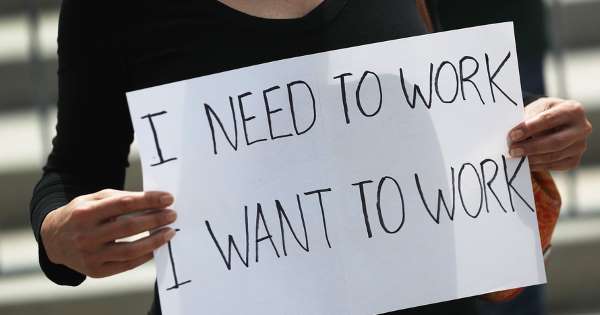
A protester joins with restaurant owners, workers and supporters to protest new measures in Miami requiring restaurants to close their indoor seating to combat the recent rise in coronavirus cases
Summer doldrums are taking on a whole new meaning during the coronavirus pandemic. The momentum in the U.S. economy appears to have melted away.

Load Error
It’s not the July heat that’s at fault, of course. It’s a wave of new outbreaks of COVID-19 across the country that has forced some states to reimpose economic restrictions and others to pause further business reopenings.
Thirty-eight U.S. states have seen a rise in cases in the past 14 days. Harvard Global Health Institute researchers have developed a national tracker to trace the severity of the outbreak on a state-by-state basis, and it’s flashing red for Arizona, Florida, Louisiana, South Carolina and Georgia, with 25 cases per 100,000 people.
The loss of momentum in the recovery is evident in key segments of the economy such as retail and dining out. Some businesses in California, Texas and elsewhere have been ordered to scale back operations again. At the same time, fear of catching the virus has made Americans more reluctant to venture out.
Two companies that track how many workers punch digital time clocks or time-tracking apps, Homebase and Kronos, indicate the number of shifts worked began to flatten out at the end of June and declined in the first week of July.
See: MarketWatch Coronavirus Recovery Tracker
Some of the decline in shifts worked is clearly the result of the July 4 holiday, but the spike in coronavirus cases has also played a role.
“Rising COVID-19 cases, particularly across the Midwest and Southeast, present a new challenge for businesses trying to reopen and stay open,” said David Gilbertson, vice president of HCM strategy and operations at Kronos.
Another worrisome sign is an explosion in the number of people applying for unemployment benefits under an emergency-federal relief program.
These claims have surged 53% in the past month to nearly 14.5 million, nearly equaling the 16.8 million people collecting benefits through the traditional state-run unemployment compensation system.
Read: Soaring demand for federal jobless benefits points to fresh fissures in the economy
And: Jobless claims tell us 32.9 million people are unemployed, but is it really that bad
Workers who file under the federal program include the self-employed such as doctors, writers, Uber (UBER) drivers and other “gig” economy workers who would not have been eligible for jobless benefits in the past.
Read: Wholesale prices drop in June — inflation very low due to the coronavirus pandemic
The increase indicates the latest economic troubles are “hitting non-traditional workers harder…
[ad_2]
Read More: Coronavirus spike in the dog days of summer saps economy of momentum