


[ad_1]
In normal times, that’d be good sign of financial responsibility. But in the pandemic era, it may just be the calm before the storm.
“People got forbearance on credit cards, mortgages and auto loans. Everything got pushed out,” Keane said. “As forbearance and stimulus wears off, we’re definitely in a rockier place.”
In other words, the financial pain got delayed, not canceled.
“It’ll almost certainly get darker from here,” Brian Wenzel, Synchrony’s chief financial officer, told CNN Business.
Bracing for bad loans
Synchrony, whose share price is down 37% this year, is reining in consumers’ ability to rack up credit card debt by lowering credit limits.
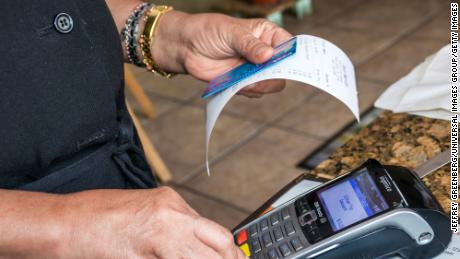
The credit card company revealed Tuesday it raised its provision for bad loans by $475 million, or 40%, during the second quarter. The surging credit costs drove a staggering 94% drop in Synchrony’s bottom line.
And yet Synchrony’s credit metrics hardly look like the United States is mired in a deep recession. (It is).
Just 3.1% of the company’s loans are 30-plus days past due. That’s down from 4.4% a year ago.
Likewise, Synchrony isn’t suffering a spike in losses on credit card defaults, at least not yet. Net charge-offs as a percentage of total average loans stood at 5.4%, down from 6% a year ago.
Americans are paying down credit card debt
But these numbers are a bit of a mirage.
Synchrony’s forbearance program is masking the financial pain. Customers enrolled in the relief program don’t have a minimum to pay, meaning they are viewed as “current” whether they choose to make a payment or not. And nearly one-third of those customers have not paid off their credit card debt at all.

Synchrony has enrolled 1.7 million customers with $3.2 billion of balances in the forbearance program since it launched earlier this year. Encouragingly, the company said nearly 70% of those customers have since left forbearance.
“Customers didn’t go out and spend. They actually…
[ad_2]
Read More: Credit card CEO warns of dark times when the $600 unemployment benefit