

[ad_1]
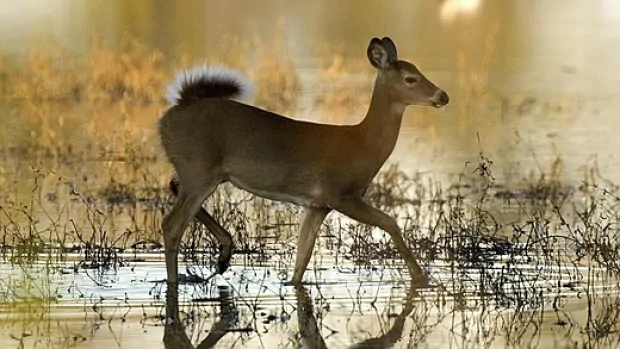
Herds of invasive white-tailed deer continue to migrate north in Alberta’s boreal forest — bolstered by milder winters and human development that cuts through the vast wilderness, a new study suggests.
The survey, recently published in the journal Nature, used 62 trail cameras to track the movements of white-tailed deer near Fort McMurray, Alta., over three years.
It’s a “deer invasion,” said Jason Fisher, study author and wildlife ecologist at the University of Victoria.
“They’re all over the landscape,” Fisher said. “They’re expanding their range. And because they’re having these negative effects on the ecosystem, they could definitely be considered invasive.”
The cameras captured more than 141,000 images, and white-tailed deer appeared in 80 per cent of them. The survey makes clear that deer are now, by far, the most prevalent large mammal in the habitat, Fisher said.
“We’re kind of feeling around in the dark. But them being there in the numbers they currently are is definitely new, it’s definitely increased, and it’s gotten a lot worse over the last decade.”
‘Deer don’t really belong in that landscape’
Deer are not native to the boreal forest and their populations are thriving, often at the expense of other species, including fragile populations of woodland caribou, Fisher said.
The deer create imbalances in the natural food chain. The herds compete with other animals, devouring the boreal forest’s limited grazing lands. Their presence also draws more predators such as wolves to the area.
It’s like a caribou, white-tailed deer teeter-totter with wolves as the fulcrum.– Jason Fisher
“The deer don’t really belong in that landscape,” Fisher said. “They’re not evolved to move quickly over snow the way that caribou are, and so they’re easy targets for wolves.
“With all these white-tailed deer around, that’s pushing wolf numbers up. With more wolves around, they’re hitting caribou harder.
“It’s like a caribou, white-tailed deer teeter-totter with wolves as the fulcrum. And that’s the big problem.”

Historically confined to the Eastern Seaboard, deer have been expanding their territory across the continent since European colonization. First they followed farmers, occupying open areas created when land was cleared of trees.
In their move north, they followed humans again, taking advantage of open grazing areas created by seismic lines and other industrial developments that cut through the thick bush.
“As agriculture swept across North America, white-tailed deer have come with it,” Fisher said. “The increase we’re seeing here in Alberta now is basically the continuation of that process. Alberta has had deer in the south ever since we’ve…
[ad_2]
Read More: Industry, mild winters clear way for white-tailed deer ‘invasion’ in